Most people searching for land in Bali start with the wrong question. They ask where is cheapest, or which area is growing fastest. Both are reasonable, but neither is where the evaluation actually begins. The real starting point is process. How you approach the search determines whether you end up with a buildable, profitable asset or an expensive problem.
Here's the framework we use with clients before recommending any land deal.
Work with fewer agents, not more
The most consistent pattern we see with investors who run into trouble is that they're talking to too many agents at once. Not two or three. Sometimes ten. The logic seems sound — more options, more leverage. In practice it creates the opposite.
When multiple agents race to close the same client, quality filtering is the first thing that goes. Plots get presented before zoning is confirmed. Conflicting information circulates. Clients receive contradictory advice on the same piece of land and have no way to evaluate which version is correct.
Our recommendation is to choose one agent, ideally a certified broker with an AREBI license, and give them time to work properly. Patience here is not passive. It's how you protect yourself from the confusion that leads to poor decisions.
Zoning and LSD: the layer most buyers underestimate
Before we present any land to a client, we verify the zoning independently. Not because we don't trust the seller, but because sellers themselves often don't know the full picture.
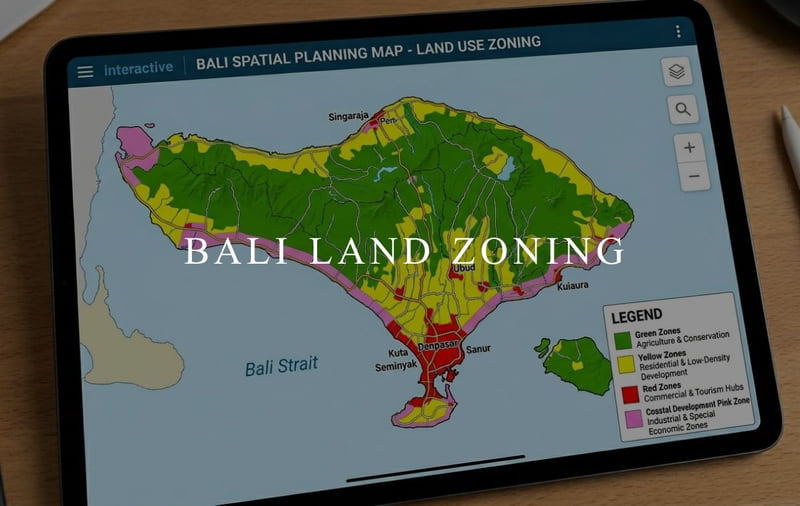
Bali uses a color-coded zoning system that determines what you can legally build:
- Pink zone (tourism): the target for most investors. Hotels, villas, and short-term rental operations are permitted here.
- Yellow zone (residential): primarily for housing. Commercial villa rentals are restricted, though a Pondok Wisata permit opens some options for smaller-scale operations.
- Orange zone (mixed use): allows residential and limited business activity. Verify what's permitted before committing.
- Green zone (agricultural): no permanent construction. Building here is illegal regardless of what anyone tells you about future rezoning.
- Red zone (commercial): trade and offices. Not ideal for residential villas but possible.
For the full breakdown, read our guide to land zoning in Bali.
There is a second layer on top of local zoning that catches many buyers off guard: LSD, or Lahan Sawah Dilindungi, a national protected rice field designation managed by the Ministry of Agrarian Affairs. A plot can appear residential on the local regency map and still be unbuildable under the national LSD register. The national designation takes precedence. If land is LSD, no building permit will be issued, full stop.
The practical protection is a conditional agreement. You sign an MOU, place a deposit in escrow with the notary, and commission due diligence. If the plot comes back as LSD, you exit the deal and recover your deposit. We've written in detail about how LSD works and how to structure the acquisition safely.
What the plot itself tells you
Once the legal layer is clear, you're evaluating the physical asset. A few things matter more than most buyers realise:
- Shape: regular, rectangular plots are easier to design and permit. Odd angles, narrow frontages, or undefined borders add cost at every stage. Irregular shapes aren't a dealbreaker, but price them accordingly.
- Slope: flat land is cheaper to build on. Sloped plots increase construction costs depending on how much fill is required. That said, slopes can be used creatively, and some of the most interesting builds in Bali take advantage of the terrain. The condition is that your architect and builder have relevant experience.
- Road access: non-negotiable. If access is unclear, disputed, or requires crossing land you don't control, don't proceed. This is one of those problems that looks solvable and rarely is.
- Vegetation: a quiet advantage. Building around mature trees adds character to a finished villa that's difficult to manufacture later.
- River-facing land: often undervalued, good for privacy and natural boundaries. The condition is that your team plans specifically for flooding. It's a design brief, not a dealbreaker.
- Views: the most overpriced element in any land conversation. Plots with a rice field or ocean panorama already price it in. A strong location with partial views and correct zoning will usually outperform a spectacular view in a poor zone. If a view matters to you, budget for it clearly rather than assuming it comes included.
How land in Bali is priced
Bali land prices, particularly for leasehold, are not regulated. There is no central registry. Pricing is driven almost entirely by what a neighbor managed to sell for.
Landowners watch each other. When someone nearby closes a deal at a higher price, the next owner adjusts upward. This continues until buyers stop paying and the market finds a new equilibrium. It is normal supply and demand operating in a market with limited comparable data.
What this means in practice: a motivated seller with clear documentation and no pressure is often a better signal of a fair deal than any per-are comparison with a plot 500 meters away. Negotiation in Bali is more about relationship and timing than benchmarks.
Land banking or development: deciding before you search
Before evaluating any specific plot, you need to know what you're actually trying to do with it. The two strategies are different enough that they point toward different types of land.
Land banking is a passive strategy. You acquire, hold, and sell when appreciation justifies it. It works well in areas with strong development trajectories, but it requires patience and a tolerance for speculation. There is no cash flow. The return comes at the end, and it depends heavily on factors outside your control.
Development puts capital to work over 18 to 24 months. You build a villa, create a revenue stream through short-term rentals, and realise returns from both the completed asset's value and ongoing income. It's more active and more complex, but it makes capital productive rather than idle.
The honest question to ask yourself before searching is: how patient am I, and what does this investment need to do in the near term?
If development is the direction, our guide to buying land step by step covers the acquisition structure, and our development service page walks through the full build process from land selection to handover.
What experience tells you that paperwork doesn't
Legal due diligence will flag title issues, zoning problems, and access disputes. That's what lawyers and notaries are for. But there's a layer of assessment that only comes from being in the room.
A few signals we look for that go beyond the legal checklist:
- The landlord is relaxed and not pushing you toward a deadline. This usually means the land is genuinely available, not being used as leverage in a parallel negotiation.
- Documents arrive quickly and without excuses. The pace of paperwork tells you a lot about how the transaction will go.
- Access is physically confirmed, not just described. We walk it.
- Zoning is verified independently before anything is presented to a client, not taken on the seller's word.
Good land tends to have three things in place: confirmed access, a straightforward landlord, and paperwork that holds up to scrutiny. When all three are present, the evaluation moves fast. When any one is missing, slow down.
Want to get started looking for land? Reach out via WhatsApp or email at agency@thebalihomes.com.
Look forward to hear what you want to build.